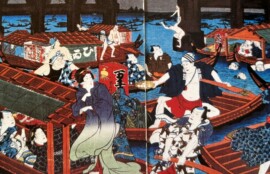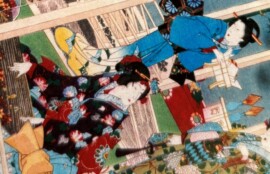
Over 400 years ago, the dance of Izumo no Okuni captivated all of the audience, which became KABUKI, and from that Japanese Dance was born. Whether you’ve seen it before or not,
we hope you find it interesting…
This time, we’d like to talk about the song “Konjiki Yasha”, which has long been beloved as a Shamisen piece similar to HAUTA.
*This site contains promotions.
|KONJIKI YASHA
The song “KONJIKI YASHA”, which begins with ‘Taking a walk along the Atami coast…’, was created based on the novel “KONJIKI YASHA” by KOYO OZAKI. “KONJIKI YASHA” means “The Golden Demon” in English.
During the Meiji era, “Speech Songs (ENKA)”, which were sung in place of speeches during the Freedom and People’s Rights Movement, initially focused on political satire and criticism of those in power. After the end of the First Sino-Japanese War in 1895, the political tone faded, and the songs evolved to sing about love and current events.
This song, “KONJIKI YASHA”, was also created by the Enka singers SHION GOTO and IKUHO MIYAJIMA, who performed it while playing the violin on street corners and in theater halls. As soon as it was released in 1918, it spread to OZASHIKI (Geisha Houses) and began to be performed as a Shamisen piece as well.
|Background
“KONJIKI YASHA” is a hugely popular romance novel from the Meiji era, serialized in the Yomiuri Shimbun by KOYO OZAKI. The serialization, which began on New Year’s Day in 1897, was published intermittently because KOYO wrote it while battling illness, and it was suspended in May 1902. The following year, KOYO passed away at the age of 35, leaving the work unfinished.
The enthusiasm of readers during the serialization was tremendous, and there is an anecdote that a young lady suffering from a serious illness said that she was more concerned about the fate of the heroine than her own life. It is said that she wished that if she died, instead of flowers or incense, copies of the newspaper containing the serialization would be placed at her grave every day.
*The Yomiuri Shimbun is published by the same company as The Japan News.
|The KOH-YO-KAN (The Maple Club)
The hilltop area behind Zojoji Temple in Shiba, where KOYO OZAKI was born and raised, was called “Momijiyama” (Maple Mountain) in the early Edo period because many maple trees were transplanted there from Kaedeyama (Maple Mountain) within Edo Castle by order of the second Shogun, TOKUGAWA HIDETADA. In one corner of the area, in 1881, the KOH-YO-KAN, a purely Japanese-style, members-only luxury entertainment venue, opened, initiated by businessmen including EIICHI SHIBUSAWA. When the ROKUMEIKAN, a Western-style social venue that opened around the same time, closed after only seven years, the KOH-YO-KAN flourished as Tokyo’s only and largest social venue.
KOYO had an affection for the local place name “Momijiyama” (Maple Mountain), and it is said that this “KOH-YO-KAN” (Maple Leaf Hall) was the inspiration for his pen name.
It is said that at the time, the waitresses (female employees) working at the KOH-YO-KAN were from respectable families and were all exceptionally beautiful. They were strictly trained in manners and etiquette, and the experience of working there was a great asset when it came to marriage. It is said that KOYO, a regular customer, used what he saw and heard there as the basis for his novel “KONJIKI YASHA”.
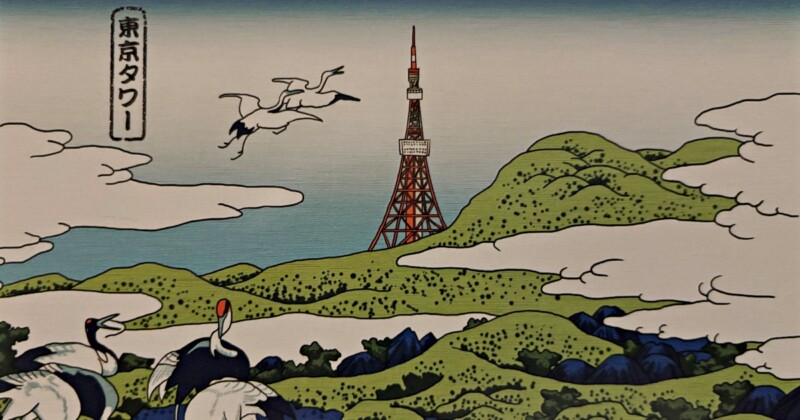
The KOH-YO-KAN flourished as a leading social venue in Japan throughout the Meiji, Taisho, and Showa periods, but it was destroyed in the Tokyo air raids of 1945. After World War II, Tokyo Tower was built on the site.
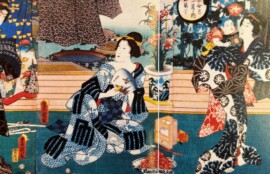
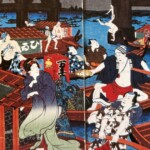
https://dcollections.lib.keio.ac.jp/ja/bon-ukiyoe/008/289
“Shiba Park Koyokan Upper Room (Japanese Restaurant)” by UTAGAWA HIROSHIGE III from Digital Collections of Keio University Libraries
◆CONTACT
https://miya-ds.com/en/contact/
◆TRIAL LESSON
https://miya-ds.com/en/trialsession/
◆JAPANESE DANCE SCHOOL MIYA
https://miya-ds.com/en/
◆MIYANAGI RYU
https://www.miyanagiryu.com