Over 400 years ago, the dance of Izumo no Okuni captivated all of the audience, which became KABUKI, and from that Japanese Dance was born. Whether you’ve seen it before or not,
we hope you find it interesting…
Today, we’ll talk about the story of the strange love of HIDARI JINGORO, a legendary sculptor from the Edo period.
| KYONINGYO
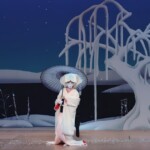
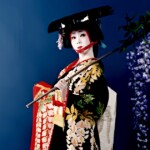
“Hako Iri Ayame Ningyo”, commonly known as “KYONINGYO”, is a popular performance piece in both KABUKI Plays and Japanese Dance. “KYONINGYO” means Japanese traditional dolls from Kyoto. It’s the story that HIDARI JINGORO, a famous Edo sculptor who was said to be able to give a soul to any living creature he carved, fell in love at first sight and carved a doll that looked just like her.
|PREMIERE
There has long been a story about the famous sculptor HIDARI JINGORO falling in love at first sight and carving a ‘Oyama Ningyo’,which means the dolls in the form of female. It is said that because OYAMA JIROSABURO, a puppet master active in the early Edo period, was particularly skilled at manipulating female-role puppets, female dolls came to be called “Oyama Ningyo” after his name. The first performance of “KYONINGYO” is said to have been in May 1843 at the Edo Ichimura-za Theatre as “Yurushi no Iro Ayame Ningyo” or in May 1847 at the Edo Kawarasaki-za Theatre as “Shiki no Hina Asakusa Hakkei”.
Lyrics by SAKURADA JISUKE III, music by KISHIZAWA SHIKISA IV. KAWATAKE MOKUAMI created “Oyobanu Ude no Hidari Horimono” based on these works. The current “KYONINGYO” is based on this play, which premiered at the Edo Ichimura-za Theatre in March 1860.
|SYNOPSIS ~ First Half
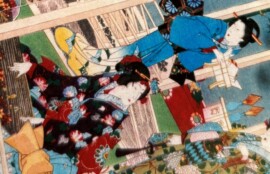
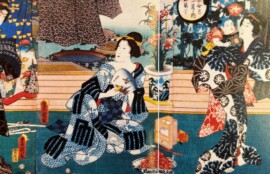
HIDARI JINGORO, a skilled carver, falls in love with OGURUMA DAYU at first sight and is completely captivated by her beauty. JINGORO pours his soul into carving a doll that looks just like her. JINGORO is so impressed by the quality of the doll that he begins drinking with it. Then, strangely enough, he notices that the doll has come out of the box the moment he looks away for just a second. JINGORO believes that the soul has resided in the doll because he carved it with his soul, and he begins to dance with the doll. However, the doll that Jingoro’s soul inhabits has rough, clumsy movements that are nothing like those of OGURUMA DAYU. So JINGORO places the hand mirror he has accidentally picked up -belonging to OGURUMA DAYU- inside the doll’s Kimono, the doll instantly takes on a womanly appearance and begins dancing, looking exactly like OGURUMA DAYU. However, when he takes out the hand mirror, her movements return to the original clumsy style. Since mirrors are such important items for women, JINGORO realizes that perhaps it is the mirror that allows the heart to reside.He dances joyfully with a doll that has her hand mirror placed inside her Kimono.
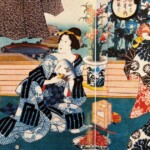
“Hida Province: (Actors BANDO HIKOSABURO V as) the KYONINGYO and (BANDO KAMEZO I as) JINGORO, from the series The Sixty-odd Provinces of Great Japan” from Museum of Fine Arts Boston
https://collections.mfa.org/objects/462508
|SYNOPSIS ~ Second Half
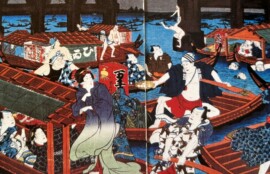
Just then, his wife OTOKU comes rushing in a panic. In fact, the family is hiding Princess IZUTSU, the younger sister of the lord whom JINGORO serves, from the enemy by disguising her as their daughter, OMITSU. However, an enemy henchman disguised as a doctor comes to examine JINGORO, suffering from lovesickness for OGURUMA DAYU, and it’s revealed that Princess IZUTSU is being hidden by JINGORO. Panicked, JINGORO cuts off the doll’s head and uses it as a fake head of Princess IZUTSU to buy time, intending to help her escape during that interval. However, TERUHEI, a servant of Princess IZUTSU, mistakenly believes that JINGORO has kidnapped her instead of hiding, and slashes at his right arm. Princess IZUTSU appears and explains the situation, but it is too late; JINGORO has lost his right arm, which is his work tool. However, as TERUHEI is apologizing, JINGORO immediately urges him to entrust Princess IZUTSU to him and escape as quickly as possible. With only his remaining left hand, JINGORO skillfully moves around using carpentry tools as weapons, driving away the henchmen.
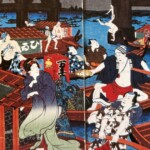
“Actor NAKAMURA FUKUSUKE I as HIDARI JINGORO” from Museum of Fine Arts Boston
https://collections.mfa.org/objects/529943
|Changes in Performance
The highlights of “KYONINGYO” are the graceful dance of the Kyoto doll in the first half and the fight between JINGORO and the enemy’s henchmen in the second half. By the way, while the first half is fine, don’t you think the second half is quite painful, with the doll’s head being cut off and the sculptor Jingoro’s right arm being severed? Perhaps that’s why the staging has changed slightly between the present and the past. Currently, the scene in which the doll’s head is cut off and offered in place of Princess IZUTSU remains in the lyrics of the song, but has been cut. As a result, the story no longer connects with the Kyoto doll section in the first half, making the second half feel abrupt. Also, the scene where TERUHEI cuts off JINGORO’s right arm has been changed to merely wounding him. However, in the final fight scene, JINGORO, who has injured his right hand, still performs using only his left hand.
The latter half has strong theatrical elements, so it is rarely performed as Japanese Dance. It is staged as a KABUKI play under the title “Meisaku Hidari Kogatana”. In any version, the easy-to-understand story of “KYONINGYO” is a popular performance piece in both Japanese Dance and KABUKI plays.
*This site contains promotions.
◆CONTACT
https://miya-ds.com/en/contact/
◆TRIAL LESSON
https://miya-ds.com/en/trialsession/
◆JAPANESE DANCE SCHOOL MIYA
https://miya-ds.com/en/
◆MIYANAGI RYU
https://www.miyanagiryu.com