Over 400 years ago, the dance of Izumo no Okuni captivated all of the audience, which became KABUKI, and from that Japanese Dance was born. Whether you’ve seen it before or not,
we hope you find it interesting…
This time, we’ll talk about the works left behind by HIDARI JINGORO, a legendary sculptor from the Edo period.
| The Legendary Sculptor
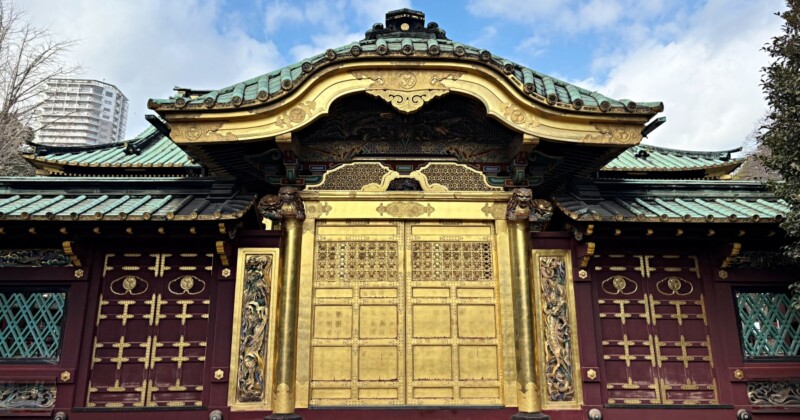
The works believed to have been carved by HIDARI JINGORO can be found throughout Japan, including the “Upward and Downward Dragons” at the Karamon Gate of Ueno Toshogu Shrine in Taito Ward, Tokyo; the “Tsunagi no Ryu”(The Chained Dragon) at Chichibu Shrine in Chichibu City, Saitama Prefecture; the “Noarashi no Tora”(The Storm-Raging Tiger) at Kokawadera Temple in Kinokawa City, Wakayama Prefecture; and the Sacred Ornament of the carp and waves on the “Koi Yama Decoration”(The decoration of Carp Float) at the Gion Festival in Kyoto. And because each work was so incredibly lifelike, there remains an anecdote that the pieces moved around. This is one reason why HIDARI JINGORO became widely known as the “Legendary Sculptor”.
| Masterpieces of HIDARI JINGORO
There are lots of anecdotes surrounding works by HIDARI JINGORO, but we’ll introduce 2 anecdotes about the “Sleeping Cat” at Nikko Toshogu Shrine in Nikko City, Tochigi Prefecture, and the “Water-Drinking Dragon” at Toeizan Kaneiji Temple in Taito Ward, Tokyo.
*There are various versions of the anecdotes, but here we’ll introduce the most widely known one.
|Sleeping Cat
The “Sleeping Cat is a national treasure sculpture located at the entrance to the mausoleum of Tokugawa Ieyasu at Nikko Toshogu Shrine. Various theories exist for why the “Sleeping Cat” was carved: to show that the Tokugawa era was peaceful enough for cats to sleep well; because it resembles a cat napping in the sunlight, in reference to the meaning of the place name “Nikko” (meaning ‘sunlight’); or because it pretends to sleep while actually guarding the mausoleum. However, there is also a theory that the “Sleeping Cat” was not asleep from the beginning. It is said that this cat ate the leftovers from a banquet celebrating the unfinished completion of the Yomeimon Gate, considered a symbol of Nikko Toshogu Shrine, so Jingorō put it to sleep with a single stroke of his sword.
*The Yomeimon Gate at Nikko Toshogu Shrine is said to have been intentionally left unfinished to ward off disaster, based on the proverb “When full, it wanes” – the idea that anything completed will eventually collapse.
|Water-Drinking Dragon
The “Upward and Downward Dragons” at Ueno Toshogu Shrine are also works by HIDARI JINGORO. Based on TOKUGAWA IEYASU’s teaching that ‘the greater the person, the more they bow their head’ (meaning truly great people are humble), the one with its head facing downward is called the “Upward Dragon”. There is a legend that these dragons also go to Shinobazu Pond night after night to drink water, but the nearby Toei-zan Kaneiji Temple also preserves a legend of the “Water-Drinking Dragon”. When the 3rd Shogun, TOKUGAWA IEMITSU, commissioned the construction of the bell tower at Kaneiji Temple, he decided to have dragon carvings placed in the transoms of the four sides—east, west, north, and south. Master carvers were gathered from all over Japan, and one of them was JINGORO. He initially declined, saying he had never seen a real dragon, but at strong request he agreed. So he made a prayer at the Bentendo Temple on Shinobazu Pond, and perhaps due to its divine blessing, he had a dream in which a pillar of water rose from the pond with a clap of thunder and a dragon flew off into the sky with great force. And so he carved his dragon, but compared to the dragons carved by the other three, his dragon had a very large head. As he said, “This dragon becomes a true dragon only when it is hung on a pillar,” and when the four dragons were hung on the pillars of the bell tower, only the dragon carved by JINGORO looked truly alive. He carved the dragon with the viewer in mind when looking up at it from below, rather than from a distance. One day, the sound of water was heard coming from Shinobazu Pond, and there was a commotion that a dragon was drinking water. After drinking the water, the dragon disappeared towards the bell tower, but at that moment the dragon carved by JINGORO was soaking wet, with droplets dripping down. Later, Shogun IEMITSU visited the bell tower and was impressed by the splendor of the dragon carved by JINGORO, but ordered the dragon to be stopped,as it would escape from the pillar every night to drink water and cause trouble to the public. JINGORO said, “I feel sorry for a dragon, but I’ll stop him,” and drove a wedge into the dragon’s head with a hammer. From that night on, he never came down to drink water again.
*This site contains promotions.
◆CONTACT
https://miya-ds.com/en/contact/
◆TRIAL LESSON
https://miya-ds.com/en/trialsession/
◆JAPANESE DANCE SCHOOL MIYA
https://miya-ds.com/en/
◆MIYANAGI RYU
https://www.miyanagiryu.com