Over 400 years ago, the dance of Izumo no Okuni captivated all of the audience, which became KABUKI, and from that Japanese Dance was born. Whether you’ve seen it before or not,
we hope you find it interesting…
This time, we’ll get closer to the true identity of HIDARI JINGORO, a legendary sculptor from the Edo period.
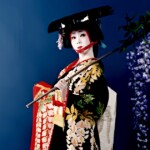
|The person believed to be HIDARI JINGORO
According to many anecdotes, HIDARI JINGORO loved alcohol and would not carve unless he was in the mood, no matter how much money he was offered. What kind of person was he?
By tracing the documents and works that remain, two figures emerge: ITAMI JINGORO TOSHIKATSU and KISHIGAMI JINGORO SAGINOBU.
|ITAMI JINGORO TOSHIKATSU
ITAMI JINGORO TOSHIKATSU was born in 1594 as the son of ITAMI SAKONNOJO MASATOSHI, a retainer of the Ashikaga clan, either in Akashi, Harima Province (present-day Akashi City, Hyogo) or in Higashisakamoto, Negoro, Kii Province (present-day Iwade City, Wakayama). After his father’s death, he took refuge with his uncle, KAWAI CHUZAEMON, a retainer of the Hida Takayama Domain. Soon after, he became a disciple of YUZA HOKYO YOHEIJI, the master carpenter of the Imperial Palace in Fushimi, Kyoto. He eventually went down to Edo and became the son-in-law of KOURA MUNEHIRO, the chief carpenter of the construction department. He gained a high reputation as a master carpenter of temples and shrines, and participated in the construction of Nikko Toshogu Shrine, Ueno Kaneiji Temple, and Shiba Taitoku-in Mausoleum, as well as the reconstruction of Edo Castle. He later became a target for assassins because, through his work as a carpenter, he knew the secret of the Nishinomaru underground passage, which was said that this passage contained the Shogun’s secret escape route. However, he defeated them, and then fled to the residence of IKOMA TAKATOSHI, the son-in-law of DOI TOSHIKATSU, the senior councilor who had been protecting him, and the lord of the Takamatsu domain in Sanuki (present-day Takamatsu City, Kagawa). After a while, he returned to Kyoto, was appointed as the head carpenter of the Imperial Palace, and after working hard on the reconstruction of Chionin Temple, he was invited to become the head carpenter of the Takamatsu Domain, where he is said to have died around 1651.
|KISHIGAMI JINGORO SAGINOBU
Originally, the mountains and foothills of Kaizuka IN Izumi Province (present-day Kaizuka City, Osaka) were rich in timber essential for construction. During the Asuka period (574–622), it is said that when Prince SHOTOKU built Shitennoji Temple in Tennoji Ward, Osaka, the timber cut from this area was transported and used for the construction. Later, during the Tenpyo period (729-749), 49 temples in Kyoto, Nara, Kawachi, Izumi, and Settsu were built using this timber by order of Emperor SHOMU. Furthermore, when TOYOTOMI HIDEYOSHI built the Jurakudai Palace in Kyoto, timber was also transported from here. It is said that HIDARI JINGORO’s ancestors, who were members of the Imperial Court architectural engineering group, moved here from Otsu in Omi (present-day Otsu City, Shiga), where the capital was located, a year before the Jinshin War in 672.
During the Muromachi period, the first-generation KISHIGAMI JINGORO SAGINOBU was born in this region to a family descended from a retainer of the Ashikaga clan. From a young age, he trained in woodworking and carving, and at the age of sixteen, he constructed the thirteen-story pagoda at Tanzan Shrine (Sakurai City, Nara). At that time, he was praised as “unrivaled” and he took on the title of “HIDARI”. Lots of carvings that are said to have been created by JINGORO’s descendants remain in the temples in the area. Furthermore, when TOYOTOMI HIDEYOSHI built Jurakudai Palace, his descendant worked as master carpenter, and during the Edo period some of them went down to Edo, changed their name to “IZUMI,” and worked as master carpenters on construction projects directly supervised by the Edo Shogunate, such as Nikko Toshogu Shrine.
*In Japan, the phrase “Nobody is right side” means “second to none,” which comes from the idea that in ancient China, the person sitting on the right had a higher rank.
*This site contains promotions.
◆CONTACT
https://miya-ds.com/en/contact/
◆TRIAL LESSON
https://miya-ds.com/en/trialsession/
◆JAPANESE DANCE SCHOOL MIYA
https://miya-ds.com/en/
◆MIYANAGI RYU
https://www.miyanagiryu.com