Over 400 years ago, the dance of Izumo no Okuni captivated all of the audience, which became KABUKI, and from that Japanese Dance was born. Whether you’ve seen it before or not,
we hope you find it interesting…
Today, we’ll introduce “SAGIMUSUME” of the NAGAUTA.
*The NAGAUTA is a classical Japanese song accompanied by Shamisen.
History
In 1662, the TAKEDA KARAKURI Theater (the TAKEDA Mechanical Puppet Theater) made
its debut performance in Dotonbori, Osaka. This theater featured mechanical puppets show
by strings and rods from behind the scenes, invisible to the audience. Their popular attractions
were puppets performing backflips, instantly changing costumes, and drawing bows and so on.
It is said that one of them was the basis for the “SAGI MUSUME”. A Sagi means a heron in
Japanese. SEGAWA KIKUNOJO II, who was very popular in Edo at the time, adapted the ideas
of TAKEDA KARAKURI Theater and performed it as a KABUKI play. It is said this was the first
time that a revolving stage was used.
In 1886, ICHIKAWA DANJURO IX a dramatically transformed the entire piece by inserting
Aikata (shamisen interludes connecting verses) into the monotonous original melody and
Hikinuki (a mechanism that changes costumes in an instant). For the entrance, the actor is
pushed forward using a device called a Shamoji, which is a large platform shaped like a rice
scoop. By using this, the actor emerges smoothly without moving his feet, which make it
possible to give the impression of a bird gliding across the surface of the water. For the finale
the heron either posing on a platform called a Nidan, or flying away in mid-air.
In 1922, Russian ballet dancer ANNA PAVLOVA came to Japan for the first time and performed
“The Dying Swan” at the Imperial Theatre, dressed as a swan.
Ballet performances, which were still relatively unfamiliar at the time, impressed many
Japanese people and had a major impact on cultural exchange. ONOE KIKUGORO VI was one of them. “The Dying Swan” was choreographed for Anna Pavlova and depicts a wounded swan
floating on a lake, struggling desperately for life until it finally takes its last breath. The painful
fluttering motion vividly expressed the suffering of a dying creature. This led to the creation of
a fantastical rendition of “SAGI MUSUME,” in which the heron dies in the snow.
“One Hundred Roles of Ichikawa Danjuro IX, SAGI MUSUME” by TOYOHARA KUNICHIKA from Honolulu Museum of Art
https://www.honoluluacademy.org/art/9815
Synopsis
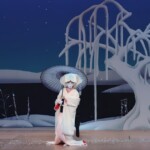
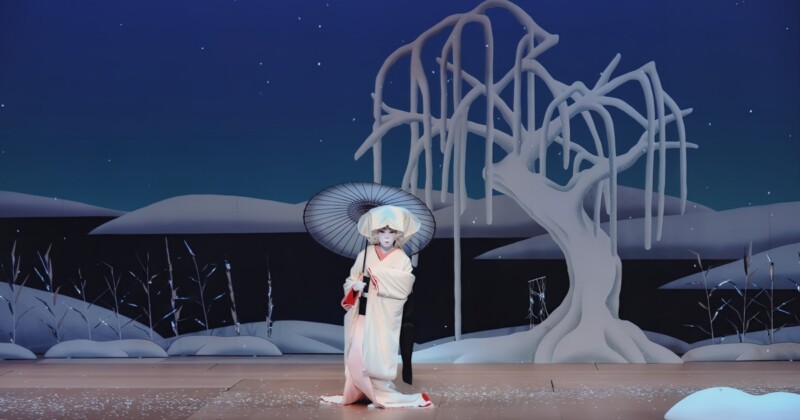
“SAGI MUSUME” is a mysterious play, with details of its story not being revealed, despite its
dramatic stage direction. A young maiden is holding an umbrella in the softly falling snow.
Wearing a white cotton hat (a bride’s headdress), a pure white Furisode Kimono with a black
Obi sash, and black lacquered geta sandals, she stands in the snow, looking as lovely as
a white egret that has descended into the snow. The maiden remembers her bitter love and,
as she walks through the snow, her movements begin to resemble those of a white egret.
Eventually, she takes the form of a town maiden and reveals her romantic feelings, but she
falls into the hell of love, suffers torment, and goes mad in agony, flapping his wings like
a heron. The story seems straightforward, but it doesn’t explain why she had to endure
the torments of hell, nor whether those torments were meant as a metaphor for the pain of
love or a punishment meted out by King of Hell.
Based on the lyrics, it is thought that the protagonist at the premiere was not a maiden,
but rather a courtesan. However, when Ichikawa Danjuro IX performed the play, the role was
changed to that of a town girl as part of a movement to improve theater.
Long time ago, in Kumano faith, there was a belief that ‘women would be punished by the birds
of Kumano after death’. It was said that courtesans who made many vows were said to fall into
the Avici Hell (hell of uninterrupted suffering) after death. It is believed that the torture of
the “SAGI MUSUME” was influenced by this belief.
“The Heron Maiden (Sagi musume)” by SUZUKI HARUNOBU from Museum of Fine Arts Boston
https://collections.mfa.org/objects/212275
*Kumano is an area stretching from the southern part of Wakayama Prefecture to the southern part of Mie Prefecture, and is a religious center of the Kumano Sanzan (3 shrines).
Source
Official Title: “YANAGI ni HINA SHOCHOU no SAEZURI”
Lyrics: unknown
Composition: KINEYA CHUJIRO
Premiere: ICHIKAWA-Za (ICHIKAWA Theatre) in April 1762
*This site contains promotions.
◆CONTACT
https://miya-ds.com/en/contact/
◆TRIAL LESSON
https://miya-ds.com/en/trialsession/
◆JAPANESE DANCE SCHOOL MIYA
https://miya-ds.com/en/
◆MIYANAGI RYU
https://www.miyanagiryu.com