Over 400 years ago, the dance of Izumo no Okuni captivated all of the audience, which became KABUKI, and from that Japanese Dance was born. Whether you’ve seen it before or not,
we hope you find it interesting…
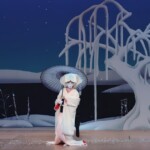
Today, we’ll introduce “HARUSHIRABE MUSUME NANA KUSA” of the NAGAUTA.
*The NAGAUTA is a classical Japanese song accompanied by Shamisen.
|SOGAMONO PLAYS & NEW YEAR’s KABUKI SHOW
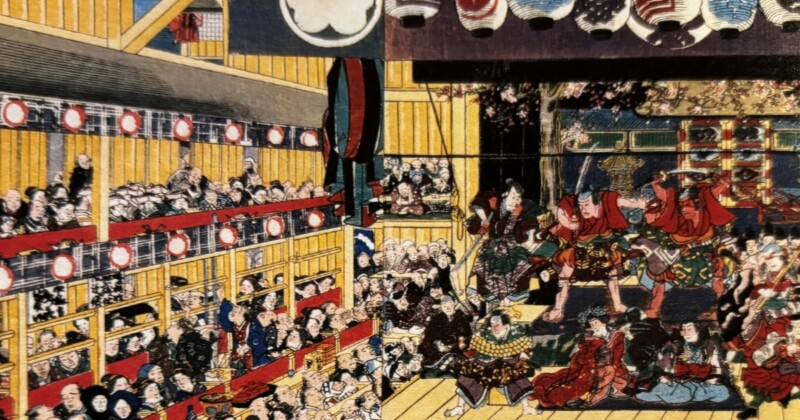
During the Edo period, it was customary for Kamigata (Kyoto and Osaka) to perform “KEISEIMONO” plays during the New Year’s holidays, and Edo to perform “SOGAMONO” plays.
|SOGAMONO PLAYS
During the Kamakura period, Kawazu Sukeyasu was killed by Kudo Suketsune over a feud for territory. Then, after 18 years of hardship, Sukeyasu’s sons, the brothers Soga Juro and Goro, avenged their father. This story became the subject of the “Soga Monogatari”. After their father passed away, the brothers took the surname of their adoptive father, Soga Sukenobu, and became known as the Soga brothers.
Many works based on the “Soga Monogatari” have been created in the fields of performing arts, such as NOH, KOWAKAMAI, JORURI, and KABUKI. Collectively, these works are called “Sogamono”.
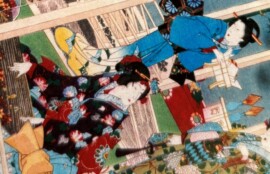
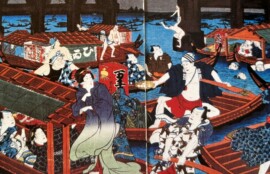
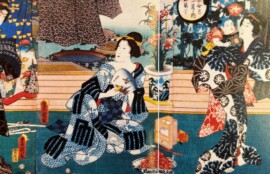
The “Soga Monogatari” is also popular as a subject for Ukiyo-e painting, and many works remain.
In this way, “Sogamono” has long been loved by the Japanese people in various fields, from performing arts to fine arts and literature.
|NEW YEAR’s KABUKI SHOW
During the Edo period, the “Soga Monogatari” became linked to the belief in spirits, and people began to appease the Soga brothers as gods at the start of the New year and pray for peace and prosperity in the coming year.
Additionally, staging a story about fulfilling one’s true purpose -revenge- during the New Year also carried the meaning of a pre-celebration, offering an advance celebration for the year’s success and achievements. Due to this background, the Soga plays came to be staged every year during the KABUKI performances of the New Year in Edo.
When the New Year’s performance of “Sogamono” became a huge hit and continued to run, the “Soga Matsuri” was held around May 28th to celebrate. This was the day the Soga brothers achieved their goal.The Soga Matsuri was originally a private ceremony held in the dressing room to express gratitude for a successful run, honoring the Soga Arajinokami deity enshrined there as the theater’s guardian spirit.
However, in 1753, the Nakamuraza’s New Year’s performance was a huge success, and they began to do the Matsuri on stage, and from then on it became a custom for the 3 Edo theaters to perform on stage. The MIKOSHI was displayed in the theater’s accounting area, the KAGURA music was performed during intermissions, and during the grand finale, the entire cast performed a spectacular dance. After the performance concluded, a banquet was held, and once it ended, they paraded through the city streets performing additional entertainment. The extravagant and lively Soga Matsuri was a fun event for the Edo commoners, where they could see popular actors up close, but at the same time, its overly extravagant performances were also subject to oppression by the Shogunate. Nevertheless, the Soga Festival continued until around the Bunsei period of the Edo era (1818-1830).
|HARUSHIRABE MUSUME NANA KUSA
“HARUSHIRABE MUSUME NANA KUSA” is one of the “SOGAMONO”.
|HISTORY
The NAGAUTA piece “HARUSHIRABE MUSUME NANA KUSA”, is a very auspicious song that weaves the custom of the Seven Herbs of Spring, observed on January 7th of “Jinjitsu no Sekku” for the Day of Mankind, into the worldview of the Soga plays.
The premiere took place in 1767 at Edo Nakamura-za, performed within the play “HATSU AKINAI OOMISE SOGA”.The composer is KINEYA ROKUSABURO II, and it is a light-hearted song that incorporates the rhythm of hitting seven herbs on a cutting board, making you can feel the warmth of early spring.
|STORY
In the early spring when plum blossoms bloom, the brothers Soga Juro and Goro visit the residence of Kudo Suketsune, a senior retainer serving Minamoto no Yoritomo.
Suketsune is the enemy who killed the brothers’ father. Though the brothers were overcome with rage at their enemy before them, they were dissuaded by Shizuka Gozen, who happened to be present.
Then, the brothers beat the Tsuzumi, while Shizuka Gozen pounded the seven herbs of spring.
Historically, the Soga brothers and Shizuka Gozen had no connection. However, they share the commonality of having enemies they wished to avenge: the Soga brothers sought vengeance for their father’s murder, while Shizuka Gozen sought vengeance for the murder of her lover, Minamoto no Yoshitsune. The act of ‘beating’ the drum and ‘pounding’ the seven herbs respectively carries the double meaning of “striking” to avenge their enemies.
And also the beautiful collaboration of two of the most popular characters in KABUKI play between the Soga brothers and Shizuka Gozen is highlight.
The freedom to disregard historical facts is astonishing, but there’s no doubt that this flexible approach has produced many masterpieces.
*This site contains promotions.
◆CONTACT
https://miya-ds.com/en/contact/
◆TRIAL LESSON
https://miya-ds.com/en/trialsession/
◆JAPANESE DANCE SCHOOL MIYA
https://miya-ds.com/en/
◆MIYANAGI RYU
https://www.miyanagiryu.com