Over 400 years ago, the dance of Izumo no Okuni captivated all of the audience, which became KABUKI, and from that Japanese Dance was born. Whether you’ve seen it before or not,
we hope you find it interesting…
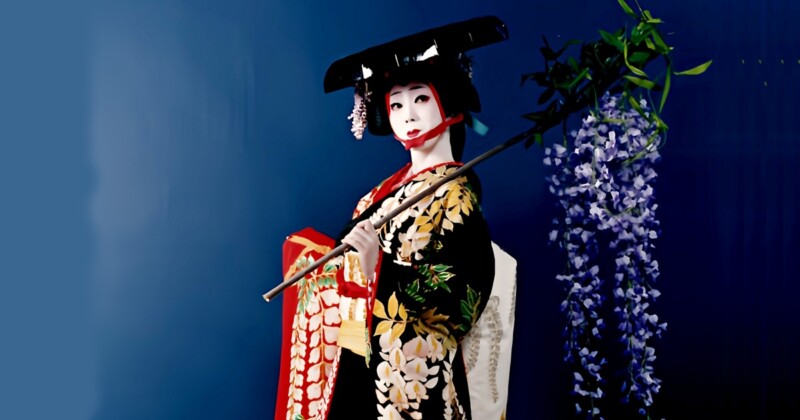
Today, we’ll introduce “FUJIMUSUME” of the NAGAUTA.
*The NAGAUTA is a classical Japanese song accompanied by Shamisen.
History
During the Edo period (1603-1868), Otsu-e Prints sold around Otsu-juku (current South of
Lake Biwa, Shiga Prefecture) on the Tokaido Road (Edo-Kyoto highway) were extremely
popular souvenirs for people traveling on foot, as they were light, inexpensive, and rare.
The immensely popular Otsu-e Prints gained further fame through the farewell performance
(“Onagori Kyogen”) staged for the popular Edo Kabuki actor Seki Sanjuro II when he returned
to his hometown of Osaka. The play was “Keisei Hangonko” by Chikamatsu Monzaemon.
In the final act of this play, 5 figures emerged one after another from the Otsu-e prints drawn
by the main character and began to dance, which were ‘the Maiden with wisteria branch’,
‘the Blind masseur’, ‘the God of learning’, ‘the Boatman’, and ‘the Slave’. This later became
5 separate dances. The wisteria maiden was the first piece in this five-transformation dance.
Near the end of the song, a dog leapt at her. Startled, the maiden who had been dancing cutely
suddenly transformed onstage into a bald blind masseur. She gave a tap with the wisteria branch
she held, and it instantly changed into a blind man’s cane. Then the Blind masseur danced
alongside the dog.
Then, in 1937, Onoe Kikugoro VI separated “Fujimusume” from the five-transformation dance,
changing the staging dirction to delete the Otsu-e prints part. He changed the character design,
making the maiden the spirit of the wisteria flower. Drawing from the legend that wisteria flowers
grow beautifully when given sake, he incorporated a scene where she drinks sake and pretends
to be drunk, completely revamping the production.
In the center of the stage, a large pine tree stands, with large, pump clusters of wisteria
blossoms hanging all around, expressing the smallness of the wisteria flower spirit, which uses
the same technique as the scene in the ballet “The Nutcracker” where Clara shrinks.
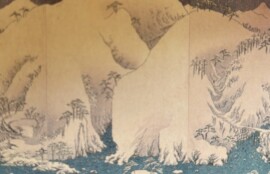
“Otsu-e: Wisteria Maiden” from Tokyo Museum Collection
https://www.edohakuarchives.jp/detail-6813.html
Synopsis
In “FUJIMUSUME”, the pine trees in the background symbolize male, while the wisteria
symbolizes female. Before a great pine tree entwined with wisteria, the wisteria flower spirit
in the form of a maiden, holding a branch, dances while lamenting the fickle heart of male.
And then, when the sound of a bell announcing the coming of dusk is heard in the distance,
the wisteria flower spirit, also disappears.
‘MUSUME’ means a maiden in Japanese, but if you listen to the lyrics, you can understand
she is an adult woman. Therefore, it is written in a very sensual way, expressing the jealousy
of the unfaithful lover and likening the wisteria vines entwined around the pine tree to the relationship between a man and a woman. At the same time, it also describes the pure feelings
of a young girl who thinks of her beloved.
“Actor Nakamura Fukusuke | as both the Wisteria Girl (Fujimusume) and a Monkey with Catfish and Gourd (Namazu hyotan)”
from Museum of Fine Arts Boston
https://collections.mfa.org/objects/464373
Source
Official Title: “KAESU GAESU ONAGORI OTSU-E”
Lyrics: KATSUI GENPACHI / MIMASUYA NISOJI
Composition: KINEYA ROKUSABURO IV / KIYOMOTO SAIBEI I
Premiere: NAKAMURA-Za (NAKAMURA Theatre) in September 1826
*This site contains promotions.
◆CONTACT
https://miya-ds.com/en/contact/
◆TRIAL LESSON
https://miya-ds.com/en/trialsession/
◆JAPANESE DANCE SCHOOL MIYA
https://miya-ds.com/en/
◆MIYANAGI RYU
https://www.miyanagiryu.com