Over 400 years ago, the dance of Izumo no Okuni captivated all of the audience, which became KABUKI, and from that Japanese Dance was born. Whether you’ve seen it before or not,
we hope you find it interesting…
Today, we’ll introduce “YASHIKIMUSUME” of the NAGAUTA and the TOKIWAZU.
*The NAGAUTA is a classical Japanese song accompanied by Shamisen.
*The TIKIWAZU is style of JORURI narrative and music used for KABUKI Dances
History
During the late Edo period, the once-popular transformantion dance fell into decline. This is
partly because, after the two masters, no actor emerged who surpassed them. Nevertheless,
the dazzling transformation dances still held an undeniable allure for audiences. The form
evolved from the transformation dance performed by one performer to by multiple performers.
The transformation dance originated with female roles, featuring various forms of young women
as its subject matter. Yet for some reason, the role of the Bukemusume (a lady-in-waiting) rarely
appeared. And finally, “YSHIKIMUSUME” appeared in the autumn section of “4 Transformations
of the 4 Seasons’ Dances”, which premiered by SAWAMURA TOSSHO at the KAWARASAKI-Za
(KAWARASAKI Theatre) in 1839. He danced in spring section as Ariwara no Yukihira, who was
a poet of the early Heian period, in summer as a boatman, in autumn as the Bukemusume, and
in winter with ICHIKAWA EBIZO V as lions. The music was NAGAUTA in spring and winter,
TOKIWAZU in summer, and a combination of NAGAUTA and TOKIWAZU in autumn. Therefore,
even after it became independent from the transformation dance, “Yashikimusume” remains in
both NAGAUTA and TOKIWAZU forms. One of this lyricist, MIMASUYA NISOJI, was the son of
a wealthy family in Asakusa. It is said that he was disowned after throwing an extravagant party
at a high-class restaurant to celebrate becoming a KABUKI playwright.
“Kabuki Playbill for Plays at the KAWARASAKI Theater: Shiki no Nagame Maru ni I no Toshi”
from Museum of Fine Arts Boston
https://collections.mfa.org/objects/225302
Synopsis
“YASHIKIMUSUME” is a woman who serves in a Daimyo’s residence (the house of Japanese
feudal lord). During the Edo period, not only daughters of samurai families but also daughters
of wealthy townspeople served in Daimyo residences to learn proper manners. This is because
if you learn proper manners, you will be able to find a good partner. To serve as a lady-in-waiting,
it was essential to master performing arts such as singing, playing instruments and dancing,
so the daughters diligently practiced from a young age. Once they began their apprenticeship,
they were not allowed to leave the employer’s residence freely, so their greatest joy was
returning to their parents’ home or going to the theater during the few days off they had each
year.
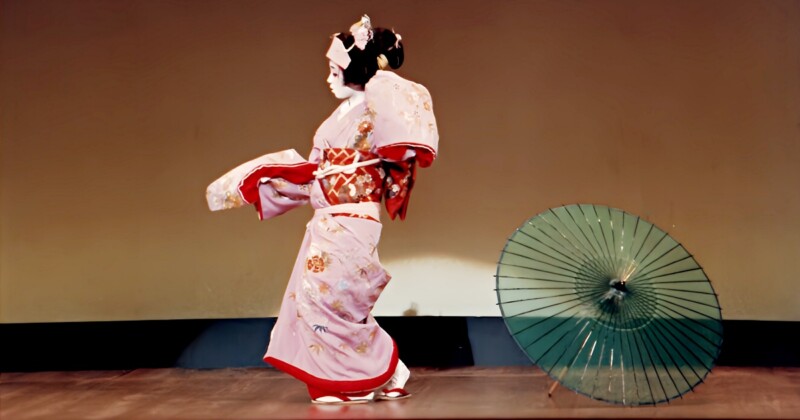
On her long-awaited day off, unable to contain her excitement, the lady-in-waiting walks lightly through the flower-filled fields, comparing herself to a flower and expressing her yearning for
love. Then, remembering the person they fell in love with at first sight during a spring cherry
blossom viewing, she enjoyed the detours playing with a ball and chasing butterflies – until it was
time to head home.
The Obi knot of ‘Yanoji Musubi’, a trademark of those who worked at the Daimyo’s residence,
is tied diagonally downwards from the left shoulder when outdoors. This was to ensure the obi
knot wouldn’t get in the way in an emergency, as the dagger for self-defense was tucked into
the left side. On the other hand, within the residence, the Obi is tied diagonally downward from
the right shoulder to the left, signifying that they had no intention of fighting.
“Third month, Set of two prints; IWAI HANSHIRO as Yashikimusume” from the Theatre Museum (Enpaku)
https://ja.ukiyo-e.org/image/waseda/101-6881
Source
Official Title: “SHIKI no NAGAME MARU ni I no TOSHI”
Lyrics: NAMIKI GOHEI III / MIMASUYA NISOJI
Composition: KINEYA SANGORO (NAGAUTA) / KISHIZAWA SHIKISA IV (TOKIWAZU)
Premiere: KAWARASAKI-Za (KAWARASAKI Theatre) in March 1839
*This site contains promotions.
◆CONTACT
https://miya-ds.com/en/contact/
◆TRIAL LESSON
https://miya-ds.com/en/trialsession/
◆JAPANESE DANCE SCHOOL MIYA
https://miya-ds.com/en/
◆MIYANAGI RYU
https://www.miyanagiryu.com