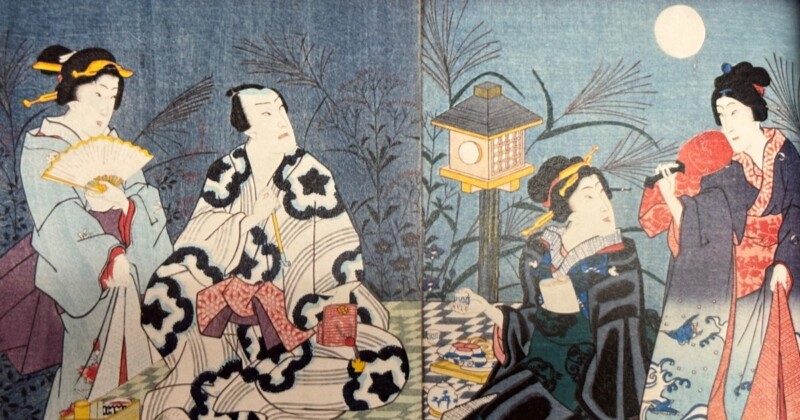
Over 400 years ago, the dance of Izumo no Okuni captivated all of the audience, which became KABUKI, and from that Japanese Dance was born. Whether you’ve seen it before or not,
we hope you find it interesting…
This time, we’ll talk about the Japanese tradition of the Thirteenth Night.
*This site contains promotions.
|The Phases of the Moon
The moon changes its appearance every night, moving from a new moon to a crescent moon, a first-quarter moon, a full moon, and a last-quarter moon before returning to a new moon once again.
This does not mean that the shape of the moon itself is changing. Rather, the part illuminated by the sun and the angle from which it is viewed from Earth.
The moon revolves around Earth, while Earth itself moves around the Sun. Because of this, the cycle of the moon’s phases is slightly longer than the moon’s orbital period around Earth.
|OTSUKIMI (Moon Viewing)
Autumn is the season when the night sky becomes especially clear and the moon appears at its most beautiful.
Before electric lights became common, people relied on the moonlight and paid close attention to its brightness and changing shape, finding in it a way to sense the changing seasons.
Even today, OTSUKIMI (moon viewing) remains a beloved autumn tradition in Japan. During this season, moon-viewing dumplings (Tsukimi Dango) and many products inspired by the harvest moon can be found in shops throughout the country.
|Mid-Autumn Festival
The custom of moon viewing on the Fifteenth Night is said to have originated from the Mid-Autumn Festival, one of the three major traditional festivals in China. For centuries, it has been celebrated alongside the Spring Festival and the Qingming Festival as one of the country’s most important annual events.
The Mid-Autumn Festival is traditionally observed on the fifteenth night of the eighth month of the lunar calendar, when people gather to admire the beautiful full moon.
In China, it has long been regarded as a time for family reunions. Family members who live apart traditionally return home for the occasion.
They spend the evening sharing mooncakes, round pastries shaped like the full moon, and exchanging gifts with relatives, friends, and loved ones as a way of expressing gratitude and wishing happiness for one another’s families.
|Another Moon
Eventually, this custom was introduced to Japan and became popular among the nobles of the Heian period as a moon-viewing event. On nights of the full moon, aristocrats held elegant gatherings where they shared sake, composed poetry aboard boats floating on garden ponds, and enjoyed the music of gagaku, the traditional court music of Japan. In this atmosphere, a unique sensitivity began to emerge. People did not simply gaze at the moon in the sky, but also admired another moon reflected on the surface of the water or in their sake cups. This was an elegant pastime enjoyed by the aristocracy, reflecting their refined aesthetic sensibility. Over time, this evolved into a uniquely Japanese appreciation of the moon: the belief that the moon dwells not only in the sky, but also within our hearts. Within this culture of moon appreciation, the Thirteenth Night came to be cherished as another celebrated moon-viewing occasion following the Fifteenth Night. Unlike the Fifteenth Night moon, the moon of the Thirteenth Night is not quite full. Yet it was precisely this slightly incomplete appearance that people found beautiful and meaningful, and the custom gradually developed into a uniquely Japanese tradition.
|SAN TSUKIMI (Three Moon-Viewing Nights)
The Fifteenth Night and the Thirteenth Night are known together as the ‘Two Moon-Viewing Nights’. It was considered unlucky to view only one of them, a custom known as katamitsuki (“one-sided moon viewing”). Adding the TOKANYA, a harvest moon celebration held on the Tenth night of the tenth lunar month, creates what is known as the “SANTSUKIMI (Three Moon-Viewing Nights)”. It is said to bring good luck if the weather is favorable and the moon can be enjoyed on all three occasions.
In the past, the moon was a much more familiar presence in people’s daily lives. It served as a guide for agricultural activities and as a way of marking the changing seasons. Because dates in the lunar calendar were based on the phases of the moon, people were naturally aware of the moon in their daily lives.
For this reason, famous moon-viewing nights were often associated with seasonal harvests. The Fifteenth Night, which coincides with the taro harvest, is also called ‘IMO MEIGETSU (Taro Moon)’. Likewise, the Thirteenth Night, which falls during the harvest season for soybeans, edamame, and chestnuts, is known as ‘MAME MEIGETSU (Bean Moon)’ and ‘KURI MEIGETSU (Chestnut Moon)’.
Just as the Japanese have long admired not only cherry blossoms in full bloom but also those that are falling, they have found beauty not only in the full moon but also in one that is not quite complete.
What kind of moon can you see tonight?
◆CONTACT
https://miya-ds.com/en/contact/
◆TRIAL LESSON
https://miya-ds.com/en/trialsession/
◆JAPANESE DANCE SCHOOL MIYA
https://miya-ds.com/en/
◆MIYANAGI RYU
https://www.miyanagiryu.com